Underwater Treadmill vs. Swim Pool: Which Does Your Dog Need?
In short: Choose the underwater treadmill for post-surgical recovery, neurological rehab, and anything where weight-bearing must be precisely controlled — water height sets exactly how much load the limb takes. Choose swim therapy for cardiovascular fitness, obesity, shoulder-and-hip range of motion, and dogs that can't or shouldn't bear weight at all. Many conditions benefit from both over a recovery course; the treadmill sessions just cost more ($55–$110 vs $35–$70 typical).
The physical difference in one sentence
On a treadmill, the dog walks; in a pool, the dog floats. Everything else follows from that.
Underwater treadmill: precision weight-bearing
Water height is the dial: shoulder-height water unloads most of the dog’s weight; hock-height water makes the leg carry almost its full share. The therapist controls belt speed, water depth, and session duration to the minute and the inch.
Best for:
- Post-surgical limb recovery (ACL/CCL, fracture repairs, FHO) — retrains the walking pattern while protecting the repair
- Neurological cases (IVDD, degenerative myelopathy, post-stroke) — the belt can move weak limbs through a gait the dog can’t generate alone
- Arthritis in weight-bearing joints — controlled walking maintains muscle without impact
- Measuring progress — limping on a treadmill is visible and comparable between sessions
Trade-offs: higher price, and some dogs need acclimation to the chamber.
Swim therapy: non-weight-bearing work
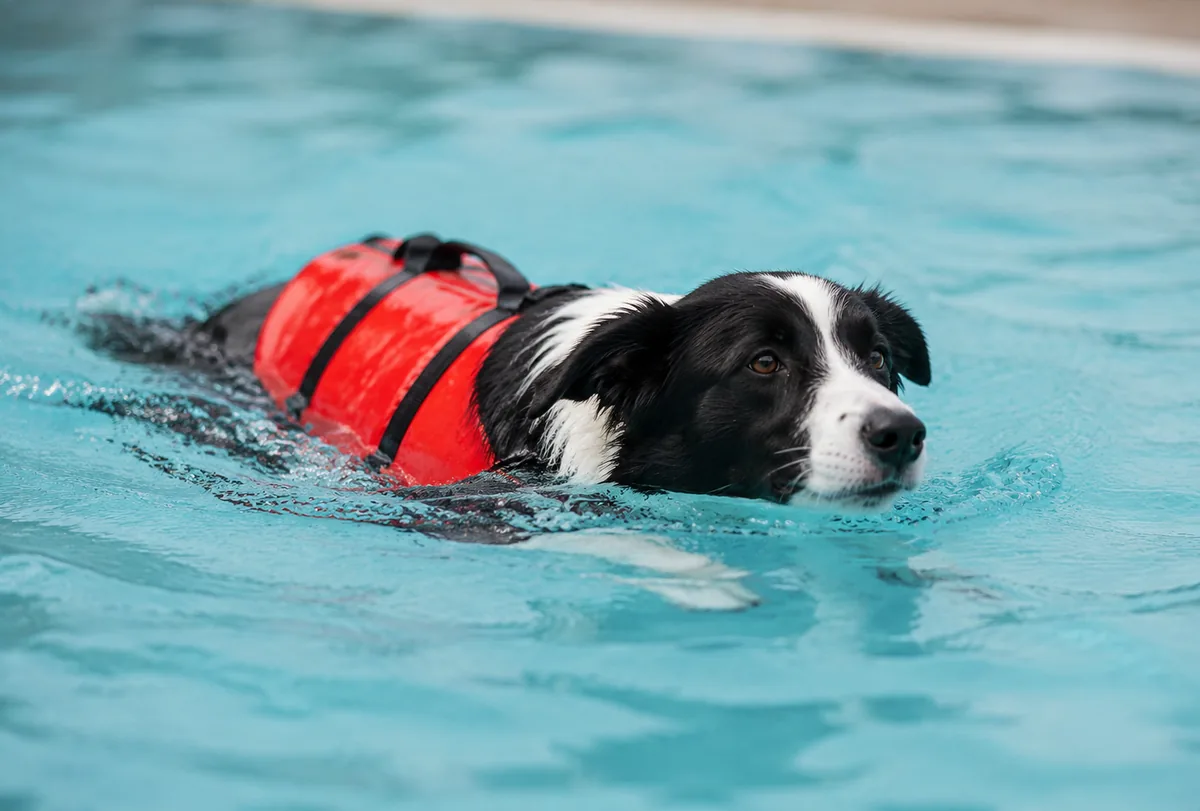
Swimming removes gravity almost entirely and works the big muscle groups — shoulders and hips especially — through a wide range of motion, with real cardiovascular load.
Best for:
- Hip and elbow dysplasia management — builds the muscle scaffold around the joint
- Obesity programs — serious calorie burn for dogs too heavy to exercise safely on land
- Conditioning for sport and working dogs
- Dogs that should not bear weight yet, in the earliest post-injury window (with vet approval)
Trade-offs: it doesn’t retrain walking, hind-limb use in swimming is often minimal (many dogs mostly “front-wheel drive” in water), and it can’t replace treadmill work for gait rehab.
The decision rule
| Situation | Start with |
|---|---|
| Post-surgery limb repair | Treadmill |
| Neuro gait retraining | Treadmill |
| Arthritis maintenance | Either — treadmill edges it |
| Dysplasia conditioning | Pool, or pool + treadmill mix |
| Weight loss | Pool |
| Dog panics in deep water | Treadmill |
For full courses, price matters: treadmill sessions run around $55–$110, swim sessions $35–$70 (see the cost guide). Ask clinics what they have before you book — and when they verify on our directory, the setup is listed right on the profile.
Common questions
Is the treadmill always better for surgery recovery?
For limb surgeries (ACL, fracture repairs, FHO) — yes, because it rebuilds walking. Swimming is non-weight-bearing by definition, which doesn't retrain gait. Some protocols use a few swim sessions early for pain-free motion, then shift to the treadmill.
My dog hates water. Is the treadmill easier?
Usually. Anxious dogs often accept a treadmill chamber better — feet on ground, water rising around them — than being lowered into a pool where they can't touch bottom. Therapists experienced with water-avoidant dogs make a big difference either way.
Can I just use a regular human pool?
For casual fitness swimming, some owners do — with a canine life vest and easy entries. For therapy, no: you lose warm water, the assistant in the water, dosing, and the safety of ramps and harnesses. And a tile pool deck with a recovering dog is a slip hazard.
Do clinics usually have both?
Larger rehabilitation centers often do; smaller hydro-only practices tend to have one or the other. Our directory listings flag the setup as clinics verify their profiles — or just ask when you call: 'treadmill, pool, or both?'
Find a clinic near you
Verified canine hydrotherapy providers across the US, searchable by city and state.